
It hurts right there. You can put a finger on it. Lying on that side at night is out of the question, and somebody has already told you it is “just arthritis, you’re getting older.”
That is often wrong, and the distinction matters, because bursitis and arthritis respond to completely different treatment. Below: what a bursa actually is, where bursitis shows up, why knee bursitis in particular gets mislabeled, how to tell the two apart, the one version that needs urgent care, and the non-surgical options available to patients across Charlotte, Matthews and Waxhaw.
What a Bursa Is and What Bursitis Means
A bursa is a thin, fluid-filled sac that sits wherever a tendon, muscle or patch of skin glides over bone. There are well over a hundred of them in the body, and their whole job is to cut friction so movement stays smooth and quiet.
Bursitis is inflammation of that sac. The lining thickens, extra fluid accumulates, and a structure designed to be frictionless becomes a pressure-sensitive source of pain. Because the bursa sits close to the surface at most sites, the pain is sharply localized and reproducible by direct pressure.
Where Bursitis Strikes
- Greater trochanteric (hip): pain over the bony point of the outer hip, worse lying on that side, climbing stairs, or standing on one leg. Frequently it involves the gluteus medius tendon as well. Explore related hip conditions.
- Subacromial (shoulder): pain on the outside of the shoulder with reaching overhead or behind the back, often alongside rotator cuff tendinopathy. See our shoulder conditions overview.
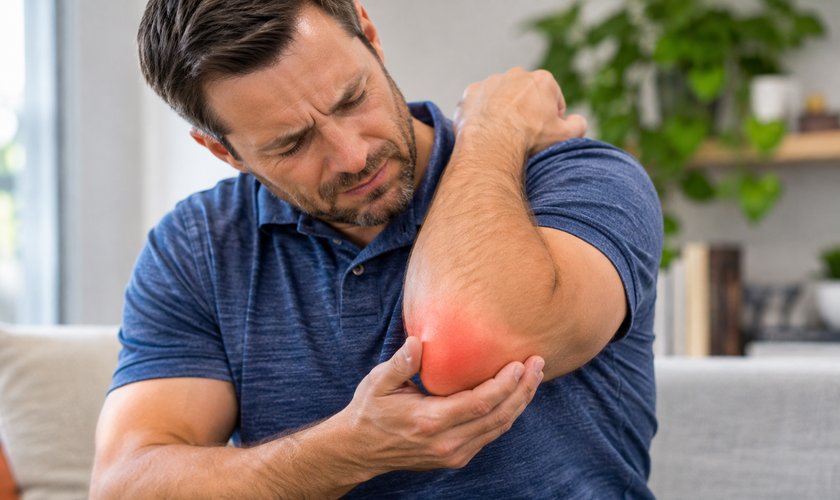
- Olecranon (elbow): a soft, goose-egg swelling right at the tip of the elbow, sometimes startling in size and surprisingly painless at first. More on elbow pain.
- Ischial: pain under the sit bone that worsens with long stretches on a hard chair or in the car.
- Prepatellar and pes anserine (knee): the two most commonly misread of the group.
Causes cluster into a few patterns: sustained or repetitive pressure, kneeling occupations such as flooring, roofing, plumbing and gardening, a sudden jump in activity after a quiet stretch, a direct blow, and underlying biomechanics. That last one gets overlooked. Weak hip abductors, a leg-length difference, flat feet or an altered gait change how load crosses a joint, and the bursa pays for it.
Knee Bursitis: The Two Patterns Worth Knowing
The knee has several bursae, and two of them cause the bulk of the trouble.
Prepatellar Bursitis
Historically called “housemaid’s knee,” this is inflammation of the sac directly in front of the kneecap. It is the classic kneeling injury: tile setters, carpet installers, roofers, plumbers and anyone who spends weekends in a flower bed. The swelling sits right on top of the patella and is easy to see. The knee joint itself usually bends and straightens fine, which is a useful clue, because the problem is in front of the joint rather than inside it.
Pes Anserine Bursitis
This one hides. The pes anserine bursa lies on the inner knee, roughly two inches below the joint line, where three tendons converge on the shinbone. Pain is felt on the inside of the knee, is worse climbing stairs or rising from a chair, and often wakes people at night when their knees press together.
It is frequently misdiagnosed as medial compartment arthritis, and the x-ray makes it worse: plenty of adults over fifty have some degenerative change on imaging, so the arthritis story looks confirmed and the real source goes untreated. The deciding test is simple. Press directly on that spot below the joint line. Pes anserine bursitis is exquisitely tender exactly there, while arthritis pain is broader and deeper. If your knee pain has one specific sore point you can cover with a fingertip, say so at your appointment.
Bursitis vs. Arthritis
Bursitis is localized and superficial. You can point to it. There is often visible swelling, it is tender to direct touch, it builds over days to weeks, and it usually traces back to a specific activity or a change in activity. Range of motion is largely preserved, even though moving through it hurts.
Arthritis is deeper and more diffuse, felt inside the joint rather than on it. Expect morning stiffness that loosens after twenty or thirty minutes, grinding or catching with movement, weather sensitivity, and a slow loss of range of motion measured in years rather than weeks.
They also coexist, often. An arthritic hip changes your gait, the altered gait overloads the trochanteric bursa, and now you have both. The practical point is that the bursitis layer is frequently the part driving your worst symptoms, and it is the part that responds fastest to treatment. Our knee conditions pages walk through the differences in more detail.
Red Flag: Septic Bursitis
A bursa close to the skin can become infected, most often at the elbow or the kneecap, particularly after a scrape or a puncture. Warning signs: skin that is hot and red rather than merely sore, swelling that is marked and rapidly progressive, fever or chills, and pain out of proportion to the usual ache.
This needs same-day medical care. It is an infection, and a steroid injection into an infected bursa makes it worse. If those signs describe you, be seen today rather than scheduling an elective injection.
When to See a Pain Specialist
Come in if the pain has outlasted a few weeks of rest and ice, if it is interrupting your sleep, if it keeps returning to the same spot, or if you have been handed an arthritis diagnosis that never quite matched where it actually hurts. Our PRP therapy page is a good place to start if a tendon is involved.
How Southern Pain and Spine Specialists Can Help
Dr. Ammar Alamarie is double board-certified in anesthesiology and pain management and a Castle Connolly Top Doctor for 2024 and 2025. Treatment starts conservatively with activity modification, ice and load management, then moves to a guided bursa injection placed precisely into the sac rather than blindly into the general area. Shockwave therapy and MLS laser therapy address the surrounding tendon, and platelet-rich plasma is an option where a tendinopathy component is driving the recurrence. We coordinate physical therapy to correct the biomechanics underneath it all, because otherwise it comes back.
No surgery is required to get out of this, and no addictive medication either. The practice is physician-owned and price transparent, with no facility fee and no surprise bills.
This article is information, not a substitute for evaluation by your own physician. You have put up with this long enough. Call Southern Pain and Spine Specialists at (980) 385-4450 to schedule at our Matthews or Waxhaw office, or request a free consultation online. Telehealth visits are available.