
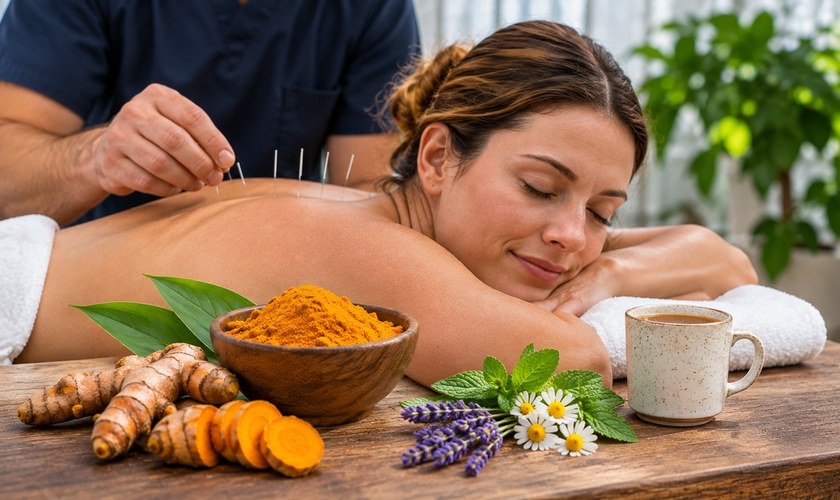
Someone has probably mentioned turmeric to you by now. A friend, a relative, a video that surfaced while you were searching at eleven at night. When pain has gone on for months and the appointments have not added up to an answer, it is reasonable to wonder whether something on a shelf could help.
We already write about anti-inflammatory eating and the vitamins patients ask about, so this is the natural next question. What does the research actually show for acupuncture, turmeric and common herbal remedies, and where are the real risks? No dismissal, no overselling.
What Acupuncture Actually Involves
Acupuncture is the placement of very thin, sterile, single-use needles at specific points on the body, usually left in for fifteen to thirty minutes. Most people describe a dull ache or a warm, heavy sensation rather than anything sharp. Some practitioners pass a mild electrical current through the needles, called electroacupuncture.
Pain researchers describe effects on local blood flow and connective tissue, release of endorphins, and shifts in how the central nervous system processes incoming signals. The mechanism is still genuinely debated, and a physician who tells you so is being accurate rather than evasive.
Where the Evidence for Acupuncture Is Strongest
Across large reviews, acupuncture tends to produce modest but real improvement in several pain conditions. Modest is not nothing, and it is not a cure.
- Chronic low back pain. One of the better-supported uses, with small to moderate gains that often fade over months without continued sessions.
- Neck pain. Reasonable support for short-term relief, particularly in chronic mechanical neck pain.
- Knee osteoarthritis. Several trials show improvement in pain and stiffness, though effects vary widely between studies. It is still worth knowing what is driving your knee pain in the first place.
- Headache and migraine. Among the more consistent findings, mainly for reducing how often headaches occur rather than stopping one already underway.
The honest complication is the sham problem. Compared against a convincing fake, the gap narrows considerably, though both usually beat no treatment. Some read that as evidence the needling matters less than the ritual and the attention; others note that a sham needle pressing on skin is not an inert placebo. Neither reading erases the relief patients report.
Serious complications are rare with a licensed practitioner and sterile single-use needles; soreness or minor bruising is brief. Talk with your physician first if you take an anticoagulant or have a bleeding disorder, if you are immunosuppressed or pregnant, or if you have an implanted device and electroacupuncture is on the table.
Turmeric and Curcumin: Real Rationale, Real Catch
Turmeric’s active compounds, the curcuminoids, interfere with several inflammatory signaling pathways in laboratory work. That is a legitimate reason to study it in arthritis, and why the supplement aisle is full of it.
The catch is absorption. Plain curcumin is poorly absorbed and cleared quickly, so much of what you swallow never reaches your joints. Manufacturers address this with piperine from black pepper, phospholipid complexes or nanoparticle formulations. A cheap bulk powder does not necessarily behave like the preparation used in a published trial.
The most studied use is knee osteoarthritis, where several trials report modest improvement in pain and function, a few finding it roughly comparable to an anti-inflammatory medication. Those trials are mostly small, short and built on different formulations, so enthusiasm should stay measured.
The cautions are not trivial. Turmeric can upset the stomach, and at higher doses it can increase bleeding risk and interact with warfarin, direct oral anticoagulants and antiplatelet drugs. It can also aggravate gallbladder problems. Anyone scheduled for an injection, an ablation or surgery must tell the physician performing it, because bleeding risk is part of planning that procedure.
The Other Supplements Patients Ask About
- Ginger. Shares some mechanisms with turmeric. Small knee arthritis studies are mildly encouraging. Also affects bleeding.
- Omega-3 fatty acids. Best evidence is in rheumatoid arthritis, where they may reduce stiffness and tender joints. Weaker for osteoarthritis.
- Glucosamine and chondroitin. Heavily studied and genuinely mixed. Large trials have largely failed to beat placebo, though some patients with worse knee pain report benefit.
- Boswellia. Several small knee osteoarthritis trials show improvement. Promising, not settled.
- Topical capsaicin. Better supported than most, with reasonable evidence in osteoarthritis and some nerve-related pain. Expect burning at first.
- Willow bark. Contains a natural salicylate, chemically close to aspirin, which means aspirin’s cautions apply, bleeding included.
The Safety Conversation Worth Having
Supplements are not held to the standard prescription medications are. They need not prove effectiveness before sale, and independent testing has repeatedly found bottles containing more, less or something other than the label claims. Two products with the same name can differ considerably in the capsule.
Natural does not mean harmless. Interactions with blood thinners, blood pressure medication, diabetes medication and sedatives are real and documented. The most common problem is not a dangerous supplement but an incomplete list: a patient who mentions prescriptions and not the four bottles in the cabinet.
Bring everything to your appointment, doses included, and say so before any procedure. Do not start, stop or change anything, prescription or supplement, because of an article. That conversation belongs with your own physician.
Where These Fit in a Real Plan
For some people these are reasonable complements, and a physician who listens will tell you when something is low risk and worth a fair trial. What none of them can do is tell you why you hurt. A supplement cannot distinguish an irritated facet joint from a disc, or arthritis from a compressed nerve root.
That is the real cost. Months spent cycling through bottles while a treatable problem goes unidentified is not a saving. These work best alongside a diagnosis, not instead of one.
How Southern Pain and Spine Specialists Can Help
At our Matthews and Waxhaw offices, Dr. Ammar Alamarie is double board-certified in anesthesiology and pain management. The first job is always the same: identify the structure actually generating your pain, then treat that root cause with the least invasive option that will work.
That includes a careful review of everything you take. Our treatments range from MLS laser therapy and trigger point injections to targeted epidural and facet procedures, built around a non-surgical, non-opioid approach. We are physician-owned and price transparent, with no facility fee and no surprise bills. If you are not sure what you have, start with the conditions we treat, organized by where it hurts.
This article is information, not medical advice for your situation. If pain is worsening, if you develop numbness or weakness, or if back pain comes with fever or loss of bowel or bladder control, seek care immediately.
Are you in pain? It’s time to do something. Call Southern Pain and Spine Specialists at (980) 385-4450 to schedule an appointment at our Matthews or Waxhaw office, or request a free consultation online. Telehealth visits are available.